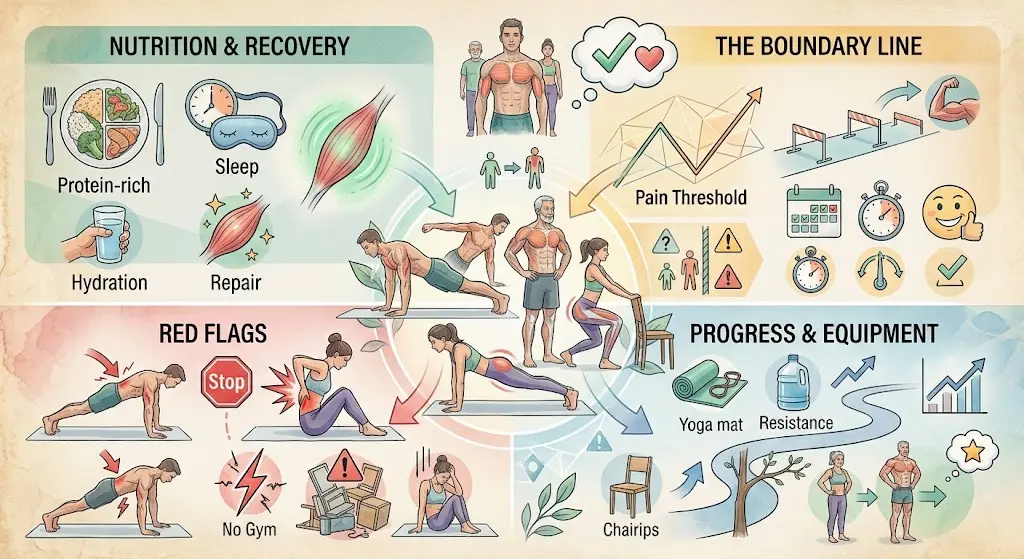
Yes, you can build muscle without a gym. Bodyweight exercises can provide enough resistance to stimulate muscle growth when you train consistently, increase exercise difficulty, eat enough protein, and allow your muscles to recover.
You do not need a room full of machines or expensive equipment to start. Your bodyweight, a small workout space, and a structured plan can be enough for many beginners.
This guide explains how to build muscle without a gym, which exercises to use, how to make them harder over time, what to eat, and how to avoid the common mistakes that slow progress.
Table of Contents
- Can You Really Build Muscle Without a Gym?
- What You Need to Build Muscle Without a Gym
- 12 Best Exercises for Building Muscle Without a Gym
- How to Use Progressive Overload Without Weights
- A 4-Week Muscle-Building Plan Without a Gym
- 20-Minute Muscle-Building Workout Without Equipment
- What to Eat When Building Muscle Without a Gym
- How Long Does It Take to Build Muscle Without a Gym?
- Why You Are Not Gaining Muscle With Home Workouts
- How to Keep Building Muscle When Bodyweight Exercises Become Easy
- Common Mistakes When Building Muscle Without a Gym
- Frequently Asked Questions
- Final Takeaway
Can You Really Build Muscle Without a Gym?
Yes. You can build muscle without a gym by using challenging resistance exercises and gradually increasing the difficulty of your training.
Muscle growth does not depend on gym machines alone. Your muscles respond to resistance and training stress. Push-ups, squats, lunges, pull-ups, split squats and other bodyweight movements can provide that resistance.
For beginners, bodyweight training can be especially useful because many basic movements are challenging enough to stimulate strength and muscle development.
However, there is an important limitation. Your body eventually adapts to an exercise. If you perform the same easy push-ups, squats or lunges for months without changing anything, progress can slow down.
That is why progressive overload matters.
You can increase repetitions, add sets, use a harder exercise variation, slow down your movements, increase your range of motion or add simple resistance such as a loaded backpack.
Your goal is not simply to exercise. Your goal is to give your muscles a reason to keep adapting.
What You Need to Build Muscle Without a Gym
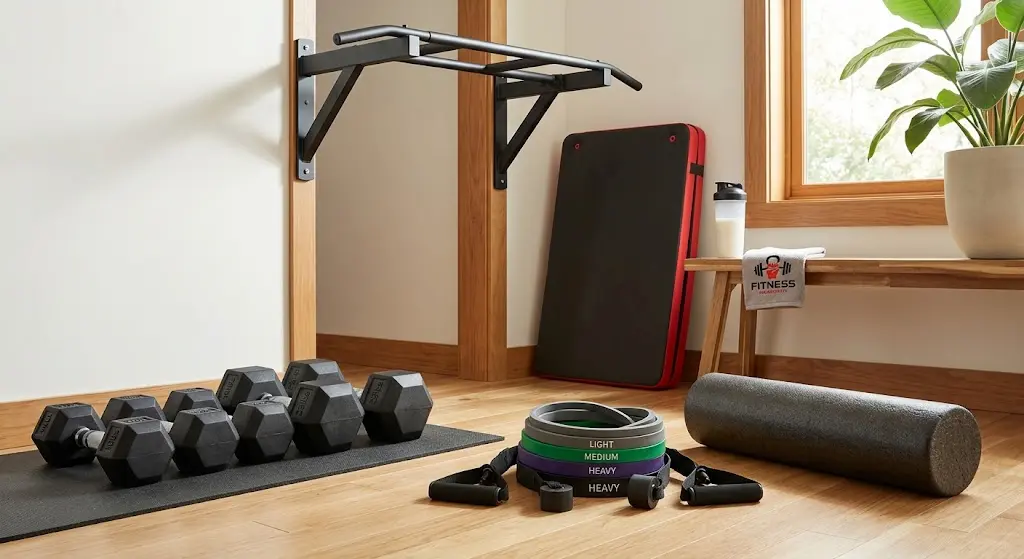
The good news is that your setup can be very simple.
Your Bodyweight
Your body provides resistance during movements such as push-ups, squats and lunges.
You can also change the leverage of an exercise to make it more difficult. A standard push-up, for example, is easier for many people than a decline or archer push-up.
A Small Workout Space
You do not need a large room.
A space where you can safely perform push-ups, squats, lunges and floor exercises is usually enough for a basic home routine.
Optional Household Resistance
If bodyweight exercises become too easy, household objects can provide additional resistance. A backpack filled with books or water bottles can make squats, lunges and some pressing movements more challenging. A resistance band or pull-up bar can also expand your exercise options.
A Way to Track Progress
Tracking is often overlooked.
Write down:
- Exercise
- Repetitions
- Sets
- Exercise variation
- Rest time
- How difficult the set felt
If you perform 10 push-ups today and later reach 15 with good form, that is measurable progress.
12 Best Exercises for Building Muscle Without a Gym
The best routine should train your major muscle groups instead of focusing on one area.
1. Push-ups
Push-ups mainly work your chest, triceps and shoulders. Beginners can start with incline push-ups using a stable elevated surface. As strength improves, move toward standard push-ups.
A possible progression is:
Incline push-up → Knee push-up → Standard push-up → Decline push-up → Archer push-up
Keep your body in a controlled position and avoid allowing your hips to sag.
2. Pike Push-Ups
Pike push-ups place more emphasis on the shoulders and triceps. Start with a comfortable range of motion. As you become stronger, gradually increase the depth of the movement. This exercise is useful when standard push-ups no longer provide enough challenge for your shoulders.
3. Pull-Ups
Pull-ups train the back and biceps while also challenging your grip. If you cannot perform a full pull-up, use an assisted variation or controlled negative repetitions. A sturdy pull-up bar can make home training much more complete because pulling exercises are harder to replicate with bodyweight alone.
4. Bodyweight Squats
Squats train the quadriceps and glutes and also involve the hamstrings. Beginners can use a chair as a depth guide if needed. Once standard squats become easy, move toward harder variations such as split squats or single-leg progressions.
5. Bulgarian Split Squats
Bulgarian split squats are excellent for training the legs one side at a time. They can become challenging without adding heavy weight because one leg performs most of the work. Keep the front foot stable and control the lowering phase.
6. Reverse Lunges
Reverse lunges work the legs and glutes while challenging balance and coordination. They are also easy to modify. Start with bodyweight. Later, you can hold a backpack or another safe source of resistance.
7. Glute Bridges
Glute bridges target the glutes and involve the hamstrings.
Lie on your back with your feet planted on the floor. Raise your hips while squeezing your glutes, then lower yourself under control.
Once two-leg bridges become easy, progress to single-leg bridges.
8. Single-Leg Glute Bridges
This variation increases the demand on each side of the body.
It is useful when regular glute bridges no longer provide enough resistance.
Focus on controlled movement rather than simply completing more repetitions.
9. Calf Raises
Calf raises are simple but effective for training the calf muscles.
Perform them on the floor first. For a greater range of motion, a stable raised surface can be used if it is safe.
Single-leg calf raises provide another progression.
10. Planks
Planks train the core and help develop trunk stability.
Keep your body controlled instead of allowing your lower back to drop.
You can increase difficulty by extending the duration or progressing to harder plank variations.
11. Leg Raises
Leg raises place emphasis on the abdominal muscles and hip flexors.
Move slowly and avoid using momentum.
If the full movement is difficult, begin with a shorter range of motion.
12. Inverted Rows
Inverted rows train the upper back and biceps.
They require a secure setup, so safety matters. Only use equipment or furniture that is specifically designed to support your body safely.
If you have access to a resistance band or pull-up bar, these can also provide useful pulling options.
Exercise Progression Guide
| Exercise | Beginner | Standard | Harder Option |
|---|---|---|---|
| Push-up | Incline push-up | Standard push-up | Decline push-up |
| Squat | Chair squat | Bodyweight squat | Split squat |
| Glute bridge | Two-leg bridge | Pause bridge | Single-leg bridge |
| Pull-up | Assisted pull-up | Pull-up | Slow negative |
| Calf raise | Two-leg | Single-leg | Loaded variation |
| Pike push-up | Elevated version | Pike push-up | Feet-elevated version |
How to Use Progressive Overload Without Weights
Progressive overload means gradually increasing the challenge placed on your muscles over time.
You do not need a barbell to apply this principle.
Add More Repetitions
If you can perform 8 controlled push-ups today, work toward 10, then 12.
Do not add repetitions simply to chase a larger number. Maintain good technique.
Add More Sets
If three sets no longer provide enough training volume, adding another set can increase the workload.
More is not automatically better, though. Your total training volume should fit your recovery ability.
Use a Harder Variation
This is one of the most useful methods for bodyweight training.
For example:
Squat → Split squat → Bulgarian split squat → Single-leg progression
The harder variation increases the resistance placed on each working muscle.
Slow Down the Lowering Phase
A controlled eccentric phase can make an exercise more demanding.
Instead of dropping quickly during a push-up, take several seconds to lower your body.
The goal is controlled resistance, not unnecessarily slow movement.
Increase Range of Motion
A larger safe range of motion can increase the challenge of some exercises.
Only use a range that you can control without pain.
Use One Side at a Time
Unilateral exercises can make bodyweight training much harder.
Examples include:
- Single-leg glute bridges
- Bulgarian split squats
- Single-leg calf raises
- Single-arm variations where appropriate
Add Simple Resistance
When bodyweight is no longer enough, a backpack can provide additional resistance for suitable exercises.
Make sure the load is secure and does not interfere with your form.
A 4-Week Muscle-Building Plan Without a Gym
A simple three-day full-body routine works well as a starting structure for many beginners.
Week 1: Learn the Movements
Focus on technique and consistency.
Monday
- Push-ups: 3 sets
- Squats: 3 sets
- Glute bridges: 3 sets
- Pike push-ups: 2 sets
- Plank: 3 sets
Wednesday
- Incline or standard push-ups: 3 sets
- Reverse lunges: 3 sets
- Glute bridges: 3 sets
- Calf raises: 3 sets
- Plank: 3 sets
Friday
- Push-ups: 3 sets
- Squats: 3 sets
- Bulgarian split squats: 2 sets
- Pike push-ups: 2 sets
- Leg raises: 3 sets
Week 2: Increase the Work
Keep the same basic structure but aim for slightly more repetitions or another set where appropriate.
Do not increase everything at once.
Week 3: Increase Exercise Difficulty
Replace selected exercises with harder versions.
For example:
- Incline push-up → Standard push-up
- Squat → Bulgarian split squat
- Two-leg bridge → Single-leg bridge
Week 4: Review Your Progress
Compare your performance with Week 1.
Ask:
- Can I perform more repetitions?
- Is my technique better?
- Can I use a harder variation?
- Do the exercises feel more controlled?
- Has my strength improved?
Simple Weekly Schedule
| Day | Activity |
|---|---|
| Monday | Full-body strength |
| Tuesday | Rest or light activity |
| Wednesday | Full-body strength |
| Thursday | Rest |
| Friday | Full-body strength |
| Saturday | Light activity or mobility |
| Sunday | Rest |
The exact schedule can be adjusted according to your fitness level and recovery.
20-Minute Muscle-Building Workout Without Equipment
Short workouts can still be useful when they are structured properly.
3-Minute Warm-Up
Use simple movements such as:
- Marching in place
- Arm circles
- Bodyweight squats
- Gentle lunges
14-Minute Strength Circuit
Perform the following movements with controlled form:
- Push-ups
- Bodyweight squats
- Reverse lunges
- Pike push-ups
- Glute bridges
- Plank
Work for a manageable period, rest briefly, and repeat according to your fitness level.
Do not sacrifice technique just to finish the circuit faster.
3-Minute Cooldown
Finish with gentle movement and relaxed stretching.
If you experience sharp pain, stop the exercise rather than trying to push through it.
What to Eat When Building Muscle Without a Gym
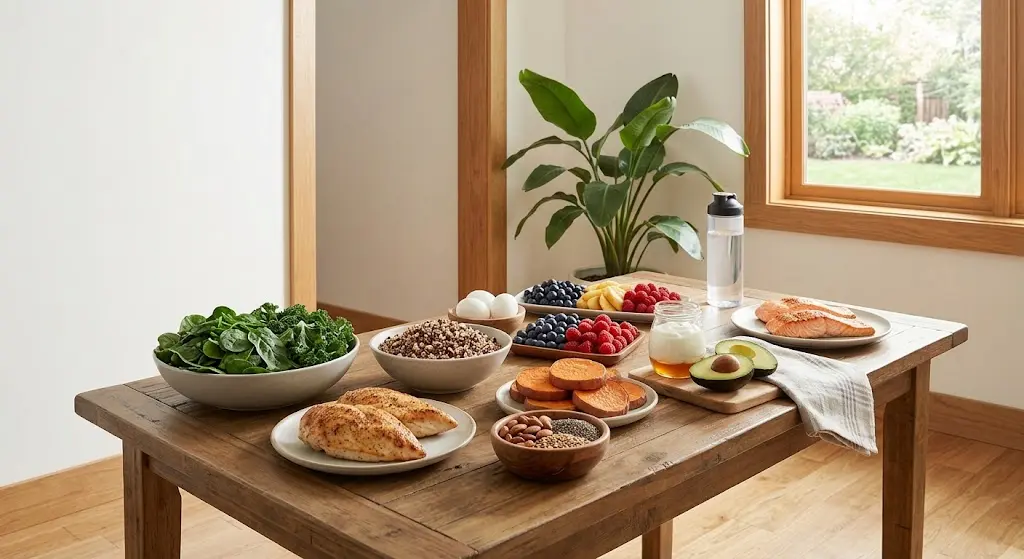
Training is only part of muscle growth.
Your body needs enough energy and nutrients to support recovery and tissue growth.
How Much Protein Do You Need?
Protein provides amino acids needed for muscle repair and growth.
Good food sources include:
- Eggs
- Chicken
- Fish
- Milk
- Yoghurt
- Lentils
- Beans
- Cottage cheese
- Nuts
- Seeds
Your total protein needs depend on factors such as body size, training, diet and goals.
Rather than relying on one meal, spread protein-rich foods across your meals.
Do You Need More Calories?
Not everyone needs a large calorie surplus.
If your goal is to gain muscle, eating enough total food is important. People who are consistently under-eating may struggle to support training and recovery.
A modest approach is generally more practical than simply eating as much as possible.
Do You Need Supplements?
No supplement is required to start building muscle.
A balanced diet can provide the nutrients needed for many people.
Supplements may have a role in specific situations, but they should not replace adequate food, training and recovery.
How Long Does It Take to Build Muscle Without a Gym?
There is no single timeline that applies to everyone.
Beginners may notice improvements in strength and exercise performance before they see major changes in muscle size.
Your results depend on:
- Starting fitness level
- Training consistency
- Exercise difficulty
- Nutrition
- Sleep
- Recovery
- Genetics
- Age
- Training history
Avoid promises of dramatic muscle growth in a few weeks.
A better approach is to monitor several forms of progress.
Track These Measurements
Strength: Are you doing more repetitions?
Difficulty: Can you perform a harder variation?
Body measurements: Are your measurements changing over time?
Photos: Do progress photos show visible differences?
Body weight: Is your weight moving in the direction that matches your goal?
Taking measurements under similar conditions makes comparisons more useful.
Why You Are Not Gaining Muscle With Home Workouts
If your training has stopped producing results, one of several issues may be responsible.
Your Workouts Are Too Easy
If you can perform very high repetitions without your muscles becoming meaningfully challenged, the exercise may no longer provide enough resistance.
Try a harder variation.
You Always Do the Same Reps
Doing exactly the same workout every week can eventually lead to a plateau.
Track your performance and gradually increase the challenge.
You Do Not Train With Enough Effort
A muscle-building set needs to be challenging.
You do not need to take every set to complete failure, but sets should generally become difficult enough to provide a meaningful training stimulus.
You Are Not Eating Enough
Consistently eating too little can make recovery and muscle gain harder.
Make sure your overall diet provides enough energy and protein for your goals.
You Ignore Recovery
Muscles need recovery between demanding sessions.
Training the same muscle hard every day is not automatically better.
Sleep and rest are important parts of a training plan.
Your Technique Needs Work
Poor form can reduce the effectiveness of an exercise and increase injury risk.
Control each repetition and use a range of motion that you can perform safely.
How to Keep Building Muscle When Bodyweight Exercises Become Easy
This is where many home workouts stop working.
The answer is not always to perform 100 repetitions.
Instead, increase the challenge.
Use This Progression System
Exercise becomes easy.
↓
Add a few controlled repetitions.
↓
Reach the top of your target range.
↓
Move to a harder variation.
↓
Add resistance if needed.
↓
Continue tracking performance.
For example, if standard push-ups become easy, you could progress toward decline push-ups instead of simply doing dozens more standard repetitions.
The same principle can be used with legs.
Bodyweight squat → Split squat → Bulgarian split squat → Loaded variation
This gives you a long-term path even without a traditional gym.
Common Mistakes When Building Muscle Without a Gym
1. Doing Hundreds of Easy Repetitions
More repetitions do not automatically mean more muscle.
If an exercise is too easy, use a harder variation.
2. Never Increasing Difficulty
Your muscles adapt to repeated training.
Give them a new challenge as your strength improves.
3. Training Hard Every Day
Recovery matters.
Give heavily trained muscles enough time to recover before another demanding session.
4. Ignoring Pulling Exercises
Push-ups train pushing muscles well, but a balanced routine also needs pulling movements.
Pull-ups, assisted pull-ups and inverted rows can help fill this gap.
5. Using Poor Form
Fast, uncontrolled repetitions can reduce the quality of your training.
Use controlled movements.
6. Skipping Leg Training
A complete routine should train the lower body as well as the upper body.
7. Not Eating Enough Protein
Your diet should include regular protein-rich foods.
8. Changing Your Routine Too Often
Give enough time to measure progress.
Constantly switching exercises makes it harder to see whether you are actually getting stronger.
9. Expecting Instant Results
Muscle growth takes time.
Focus on consistent training rather than dramatic short-term promises.
Frequently Asked Questions
Can you build muscle without a gym?
Yes. Bodyweight exercises and other forms of resistance training can help build muscle when they provide enough challenge and are progressed over time.
Can you build muscle without weights?
Yes. Beginners can often make substantial progress with bodyweight movements. As strength increases, harder variations, resistance bands or household resistance can provide additional challenge.
How many days a week should I train without a gym?
A three-day full-body routine can be a practical starting point for many beginners. Your schedule should also include recovery days.
Can push-ups build muscle?
Yes. Push-ups can train the chest, shoulders and triceps. Progressing to harder variations can help maintain the challenge as your strength increases.
Can squats build muscle without weights?
Yes. Bodyweight squats can train the legs, particularly the quadriceps and glutes. Harder variations such as split squats and Bulgarian split squats can increase the challenge.
How much protein do I need to build muscle?
Protein needs vary according to body size, activity level, training goals and other factors. Include protein-rich foods regularly and consider your overall diet rather than focusing on a single meal.
How long does it take to see muscle growth?
There is no universal timeline. Strength improvements may occur before obvious changes in muscle size. Consistent training, adequate nutrition and recovery all influence results.
What should I do when bodyweight exercises become too easy?
Increase repetitions or sets first, then consider a harder exercise variation, greater range of motion, slower controlled repetitions or additional resistance.
Final Takeaway
You do not need a gym to start building muscle.
A structured bodyweight routine can give beginners an effective starting point. The key is to make your training progressively harder rather than repeating the same easy workout indefinitely.
Start with exercises such as push-ups, squats, lunges, glute bridges, pike push-ups and core movements. Train consistently, eat enough protein and overall food to support your goal, sleep well and track your progress. Most importantly, give your muscles a reason to adapt.