
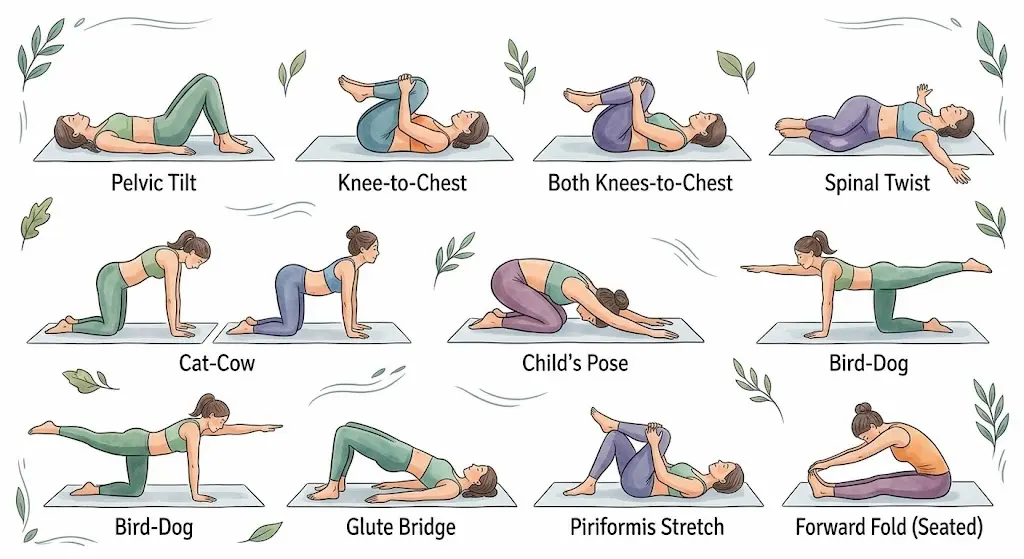
Lower back pain can make ordinary activities such as sitting, walking, bending and getting out of bed uncomfortable. Exercise is often part of managing low back pain, but there is no single movement that works best for every person.
The most useful exercise depends on the person’s symptoms, movement tolerance, fitness level and the cause of the pain. For many people with nonspecific low back pain, a combination of gentle mobility, strengthening, trunk control and aerobic activity can be more useful than relying on one stretch.
Research supports best exercise for the lower back pain as an effective part of care for many people with chronic nonspecific low back pain. A large Cochrane review included 249 studies and found that exercise probably reduces pain compared with no treatment, usual care or placebo.
The goal is not to force the spine into painful positions. The goal is to gradually restore movement, build strength and improve the ability to perform everyday activities.
Quick Answer: What Exercises Help Lower Back Pain?
The best exercises for lower back pain depend on the individual, but commonly used options include:
| Exercise | Main purpose |
| Walking | Aerobic fitness and general movement |
| Pelvic tilts | Gentle lumbar movement |
| Knee-to-chest stretch | Hip and lower-back mobility |
| Cat-cow | Spinal mobility |
| Glute bridge | Glute and hip strength |
| Bird dog | Trunk control and endurance |
| Modified curl-up | Core endurance |
| Side plank | Lateral trunk strength |
| Hamstring stretch | Posterior-leg flexibility |
| Hip flexor stretch | Hip mobility |
Not every exercise is suitable for every type of back pain. An exercise that feels comfortable for one person may aggravate symptoms in another. NHS guidance recommends staying active where possible and notes that exercises and stretches can help with back pain, while advising people to stop if symptoms become worse.
Can Exercise Really Help Lower Back Pain?
Yes, exercise can help many people with lower back pain, particularly when it is part of an appropriate and progressive programme. The evidence does not show that one particular exercise is universally superior. Instead, studies have evaluated many forms of exercise, including core strengthening, general strengthening, aerobic exercise, Pilates and mixed exercise programmes.
A systematic review conducted to inform WHO guidance found that structured exercise programmes probably reduce pain and functional limitations in adults and older adults with chronic primary low back pain. However, the certainty of evidence for individual exercise types was often low or very low. This is important because online articles sometimes describe one exercise as a guaranteed solution.
Lower back pain is more complicated than that. A better approach is to find movements that the person can perform comfortably, then gradually build movement capacity and strength.
10 Best Exercises for Lower Back Pain
1. Walking
Walking is one of the simplest ways to remain active when the back is sensitive. It does not require special equipment, and the intensity can be adjusted easily. A beginner can start with a short walk and increase the duration gradually.
For example:
- Start with 5 to 10 minutes.
- Use a comfortable pace.
- Increase the duration gradually.
- Take short breaks when necessary.
- Avoid turning the walk into a hard workout during a painful flare-up.
Walking is particularly useful because it adds aerobic activity without requiring complicated movements. Exercise research includes walking and other aerobic programmes among the approaches studied for chronic low back pain.
2. Pelvic Tilts
Pelvic tilts provide a gentle way to practise controlling movement around the pelvis and lower back.
How to do pelvic tilts
- Lie on the back with the knees bent.
- Keep the feet flat on the floor.
- Gently tighten the abdominal muscles.
- Slowly tilt the pelvis so the lower back moves toward the floor.
- Return to the starting position.
- Repeat slowly.
The movement should remain controlled. The goal is not to force the lower back into a large range of motion.
3. Single Knee-to-Chest Stretch
The knee-to-chest movement is commonly used as a gentle mobility exercise. HSS includes the single knee-to-chest stretch among its lower-back exercises.
How to do it
- Lie on the back with both knees bent.
- Bring one knee toward the chest.
- Hold behind the thigh rather than pulling aggressively on the knee.
- Hold for a comfortable period.
- Return the leg slowly.
- Repeat on the other side.
The stretch should feel gentle rather than sharp.
4. Cat-Cow
Cat-cow is a controlled spinal mobility exercise performed on hands and knees.
How to do it
- Start on hands and knees.
- Keep the hands below the shoulders.
- Keep the knees below the hips.
- Slowly round the back.
- Move gradually in the opposite direction.
- Repeat without forcing the range.
The movement is intended to encourage comfortable spinal motion. If a particular direction increases symptoms significantly, the person should reduce the range or stop and seek professional advice if needed.
5. Glute Bridge
The glute bridge strengthens the muscles around the hips and buttocks. Strong glute muscles can contribute to efficient movement during activities such as walking, standing and lifting.
How to do a glute bridge
- Lie on the back with knees bent.
- Place the feet comfortably on the floor.
- Keep the arms relaxed beside the body.
- Gently brace the abdomen.
- Press through the feet.
- Lift the hips gradually.
- Pause briefly.
- Lower the hips with control.
The movement should come from the hips rather than excessive arching of the lower back.
6. Bird Dog
The bird dog is a trunk-control exercise performed from a hands-and-knees position. It is also one of the three exercises commonly known as the McGill Big 3.
How to do a bird dog
- Start on hands and knees.
- Keep the spine in a comfortable neutral position.
- Extend one arm and the opposite leg.
- Keep the hips level.
- Hold briefly.
- Return slowly.
- Repeat on the opposite side.
The goal is controlled movement rather than lifting the limbs as high as possible. The bird dog focuses on maintaining trunk control while the arms and legs move.
7. Modified Curl-Up
The modified curl-up is another exercise associated with the McGill Big 3. Unlike a traditional sit-up, the movement is designed around maintaining a relatively stable spine while engaging the abdominal muscles.
How to do it
- Lie on the back.
- Keep one knee bent and the other leg extended.
- Place the hands underneath the lower back.
- Gently brace the abdominal muscles.
- Lift the head and shoulders slightly.
- Hold briefly.
- Lower with control.
The movement should be small. A traditional high-repetition sit-up is not required to build core endurance.
8. Side Plank
The side plank trains the muscles responsible for lateral trunk stability. Beginners can perform a modified version with the knees bent.
How to do it
- Lie on one side.
- Place the elbow underneath the shoulder.
- Bend the knees for an easier version.
- Brace the abdominal muscles.
- Lift the hips.
- Hold a comfortable position.
- Lower slowly.
The duration should be based on current ability. Quality is more important than trying to hold the position for as long as possible. The modified curl-up, side plank and bird dog form the commonly discussed McGill Big 3. HSS and physiotherapy sources describe these exercises as ways of developing trunk stability and endurance.
However, the McGill Big 3 should not be presented as the only or universally best solution. Evidence supports several forms of exercise for low back pain, and individual response matters.
9. Hamstring Stretch
Tightness around the back of the thigh can affect comfortable movement, although tight hamstrings are not automatically the cause of lower back pain. HSS includes a hamstring stretch in its lower-back exercise guidance.
How to do it
- Lie on the back with the knees bent.
- Raise one leg.
- Hold behind the thigh.
- Slowly straighten the knee until a comfortable stretch is felt.
- Do not force the leg.
- Return to the starting position.
A stretch should not create sharp pain, numbness or increasing symptoms.
10. Hip Flexor Stretch
Hip flexor mobility can be useful when prolonged sitting has made the hips feel stiff. HSS includes a hip flexor stretch among its lower-back exercise recommendations. The stretch should be gentle and controlled. A person should avoid forcing the lower back into a large arch to create a stronger sensation.
How to Choose the Right Exercise
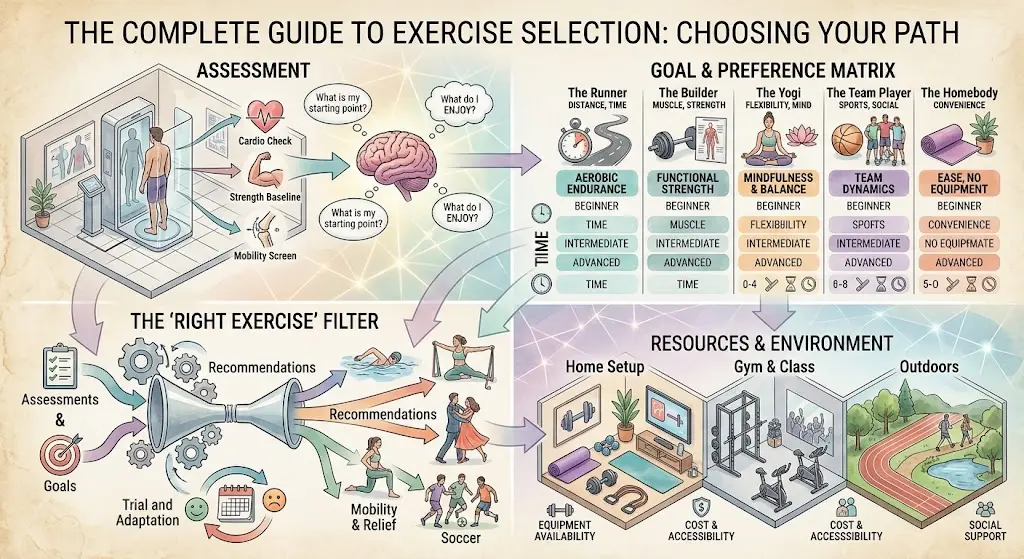
The right exercise is usually the one that can be performed with good control and without significantly worsening symptoms.
A simple approach is:
For stiffness
Gentle mobility exercises may be useful.
Examples include:
- pelvic tilts
- knee rolls
- cat-cow
- gentle walking
For weakness
Progressive strengthening may be appropriate.
Examples include:
- bridges
- bird dogs
- modified curl-ups
- side planks
For general fitness
Aerobic activities can be useful.
Examples include:
- walking
- swimming
- cycling
- other comfortable low-impact activities
WHO guidance supports exercise programmes as part of nonsurgical management for chronic primary low back pain but emphasises person-centred care rather than one universal routine.
Beginner 10-Minute Lower Back Routine
A simple beginner routine can combine mobility, strengthening and walking.
Warm-up
2 minutes: gentle walking around the room.
Mobility
Pelvic tilts: 8 to 10 repetitions.
Cat-cow: 6 to 8 slow repetitions.
Strength
Glute bridge: 6 to 10 repetitions.
Bird dog: 5 repetitions per side.
Core
Modified side plank: short, comfortable holds on each side.
Finish
2 minutes: easy walking.
The exact number of repetitions should be adjusted to the person’s tolerance. There is no requirement to complete the entire routine if symptoms become significantly worse.
How Often Should Someone Exercise?
There is no single frequency that works for everyone. A person beginning exercise after a period of inactivity may need shorter and less frequent sessions. The general principle is:
Start with a manageable amount and gradually build up.
Guy’s and St Thomas’ NHS recommends using the person’s recent activity level as a starting point, breaking tasks into smaller steps when necessary and gradually increasing activity over time. Consistency is generally more useful than performing a difficult routine once and then avoiding movement for several days.
Should Lower Back Exercises Hurt?
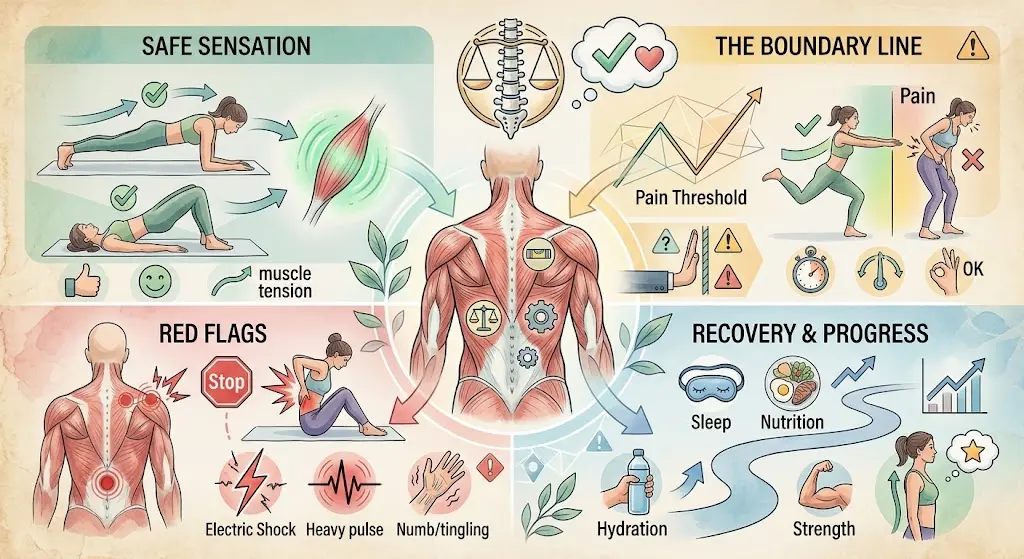
Exercise can sometimes produce mild temporary discomfort or muscle soreness, particularly when someone is returning to activity. However, pain should not be ignored simply because an exercise is supposed to be therapeutic.
An exercise should be modified or stopped if it produces:
- sharp pain
- rapidly increasing pain
- new numbness
- new weakness
- significant tingling
- pain that increasingly travels down a leg
- symptoms that remain substantially worse afterward
Guy’s and St Thomas’ NHS advises people to pace activity if exercise causes pain that they cannot tolerate and to build activity gradually.
Exercises to Be Careful With During a Pain Flare-Up
There is no universal list of exercises that every person with back pain must avoid. However, some movements may aggravate symptoms depending on the underlying problem. People should be cautious with:
- heavy lifting
- high-load spinal movements
- sudden twisting
- aggressive stretching
- high-impact exercise
- movements that repeatedly worsen symptoms
- exercises performed through sharp pain
A common mistake is assuming that a harder exercise will produce faster recovery. For lower back pain, gradual progression is usually more appropriate than suddenly adding heavy resistance or high-volume training.
Walking and Other Low-Impact Activities
Walking can be a useful starting point for people who are able to tolerate it. Swimming, cycling, yoga and Pilates may also be appropriate for some people. The NHS lists these activities among options that may help ease back pain. The best activity is often the one that can be performed consistently without causing a significant symptom flare.
Acute vs Chronic Lower Back Pain
Not all lower back pain is the same. Acute low back pain generally refers to pain that has recently started. Chronic low back pain is commonly defined in research as pain lasting at least 12 weeks.
The evidence for structured exercise is particularly strong for chronic nonspecific low back pain, but exercise approaches are also used in the management of acute and subacute presentations depending on the clinical situation. Clinical practice guidelines support exercise interventions for several low-back-pain populations. People with a new injury, neurological symptoms or unusual symptoms should not assume that a generic online exercise routine is appropriate.
When Lower Back Pain Needs Medical Attention
Most lower back pain does not indicate a serious disease, but certain symptoms require medical assessment. Urgent medical attention is particularly important when back pain is accompanied by:
- inability to pass urine
- loss of bladder or bowel control
- numbness around the genitals or buttocks
- numbness or weakness affecting both legs
- significant trauma
- fever or feeling very unwell
- unexplained major weight loss
- a history of cancer
Guy’s and St Thomas’ NHS identifies these as red-flag symptoms that can require prompt medical assessment. Severe or rapidly worsening pain should also receive appropriate medical evaluation.
How to Progress After Lower Back Pain Improves
The goal of exercise should not be to perform the same gentle routine forever. As symptoms improve, a person can gradually develop greater physical capacity.
A sensible progression can look like:
Stage 1: Gentle mobility
Stage 2: Basic trunk and hip activation
Stage 3: Endurance exercises
Stage 4: Progressive resistance training
Stage 5: Functional movements
Stage 6: Return to normal work, sport or recreational activities
For example, a bridge may eventually progress from bodyweight repetitions to a more challenging variation when appropriate.
A bird dog may progress through longer controlled holds or more demanding variations. A person returning to lifting may eventually reintroduce squats, hinges and other functional movements under appropriate guidance.
Common Mistakes to Avoid
Doing Too Much Too Soon
A large increase in exercise volume can aggravate symptoms.
Searching for One Magic Exercise
Lower back pain has many possible contributors, so one exercise cannot be expected to solve every case.
Stretching Everything
Stretching can be useful, but strengthening and general activity are also important components of many exercise programmes.
Avoiding All Movement
Long periods of inactivity are generally not recommended for ordinary back pain. The NHS specifically advises against staying in bed for long periods.
Ignoring Nerve Symptoms
Pain accompanied by numbness, weakness or other neurological changes needs more careful assessment.
Copying an Advanced Routine
A routine designed for an athlete or experienced lifter may be inappropriate for someone who is currently experiencing significant pain.
Frequently Asked Questions
What is the best exercise for lower back pain?
There is no single best exercise for everyone. Walking, mobility exercises, bridges, bird dogs, modified core exercises and other structured exercise approaches can be useful depending on symptoms and individual tolerance.
Are stretches good for lower back pain?
Gentle stretching can help some people with stiffness and mobility. However, stretching is not the only useful approach. Strengthening and aerobic activity can also be part of a broader exercise programme.
Is walking good for lower back pain?
Walking can be a useful low-impact activity for many people with lower back pain. The duration and pace should be increased gradually according to tolerance.
Are bridges good for lower back pain?
Glute bridges can strengthen the glute muscles and contribute to hip and trunk strength. They should be performed with controlled movement and without forcing the lower back into excessive extension.
Is the McGill Big 3 good for lower back pain?
The McGill Big 3, consisting of the modified curl-up, side plank and bird dog, can be useful exercises for trunk endurance and control. However, current evidence does not establish them as universally superior to all other appropriate exercise programmes.
How often should someone do lower back exercises?
Frequency depends on the exercise, symptoms and individual fitness level. A gradual and consistent approach is generally preferable to performing a very demanding routine infrequently.
Should someone exercise with lower back pain?
Many people can remain active with lower back pain, but exercise should be adapted to their symptoms and ability. Significant worsening, neurological symptoms or red flags require appropriate medical assessment.
Can exercise cure lower back pain?
Exercise should not be described as a guaranteed cure. Evidence shows that structured exercise can reduce pain and improve function for many people with chronic primary low back pain, but results vary between individuals.
What exercises should be avoided with lower back pain?
There is no universal list because tolerance differs. People should be cautious with movements that cause sharp, worsening or radiating symptoms and should seek professional guidance when symptoms are severe or unusual.
Can core exercises help lower back pain?
Core strengthening and trunk endurance exercises are among the exercise approaches studied for low back pain. Clinical guidelines include trunk strengthening, endurance and movement-control exercises among possible interventions.
When should someone see a doctor for lower back pain?
Medical assessment is appropriate when pain is severe, worsening, persistent, follows significant trauma or occurs with neurological symptoms or other red flags such as bladder or bowel changes, saddle numbness, fever or unexplained weight loss.
Key Takeaways
- There is no single universally best exercise for lower back pain.
- Exercise therapy can help many people with chronic nonspecific low back pain.
- Walking is a simple way to maintain activity.
- Gentle mobility can help people who feel stiff.
- Bridges can strengthen the glutes and hips.
- Bird dogs can develop trunk control.
- Modified curl-ups and side planks can develop core endurance.
- The McGill Big 3 are useful options but are not a universal solution.
- Exercise should progress gradually.
- Sharp or significantly worsening pain should not be pushed through.
- New neurological symptoms require medical attention.
- Bladder or bowel changes and saddle numbness are urgent warning signs.
- Consistency and gradual progression are generally more important than finding a single “magic” exercise.
Conclusion
The best exercises for lower back pain are not necessarily the most difficult exercises or the stretches that create the strongest sensation. The most useful movements are those that fit the person’s symptoms, ability and goals and can be performed consistently.
For many people, a balanced approach can include gentle mobility, walking, hip and glute strengthening, trunk-control exercises and gradual resistance training. Evidence from large reviews supports structured exercise as an important part of managing chronic primary low back pain, although individual exercise types do not work equally for everyone.
The McGill Big 3, including the modified curl-up, side plank and bird dog, can be included in an exercise programme, but they should be viewed as useful tools rather than a universal cure.
Most importantly, exercise should progress gradually. If back pain becomes significantly worse, or if symptoms such as leg weakness, numbness, bladder or bowel changes or saddle numbness develop, medical assessment should take priority over an online exercise routine.