
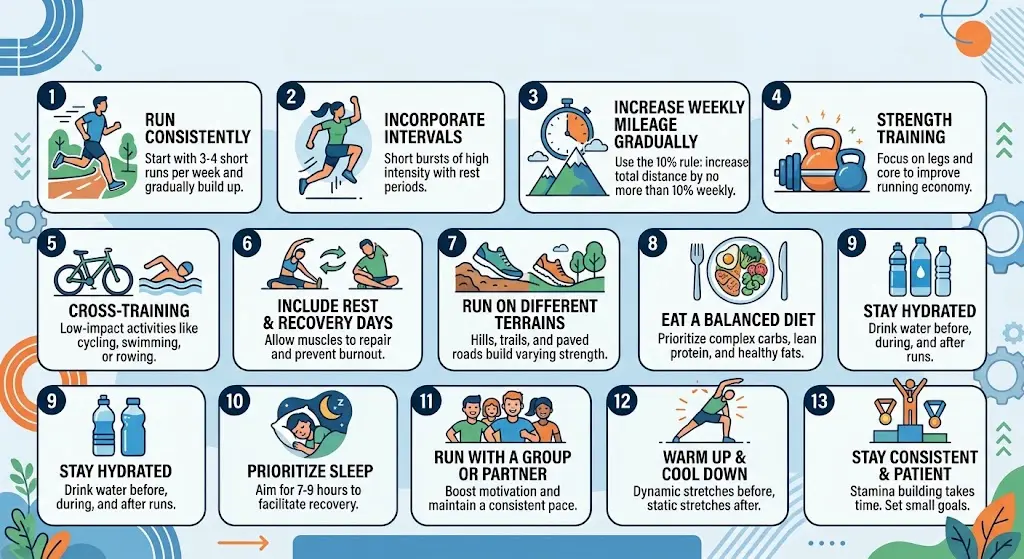
Increase stamina for running. Stamina does not improve from simply running harder every day. A stronger runner usually develops stamina through a combination of easy aerobic running, gradual progression, occasional harder workouts, strength training, proper fuelling, hydration and enough recovery.
For beginners, the biggest mistake is often starting too fast. A pace that feels comfortable may seem too slow, but it allows the body to spend more time building aerobic fitness without creating excessive fatigue.
Research on endurance runners also supports a training pattern with a large amount of lower-intensity work and a smaller amount of harder training. A systematic review found that training approaches with a high volume of low-intensity running and a smaller amount of threshold or high-intensity work can support endurance adaptations.
Quick Answer: How Can Running Stamina Improve?
The most reliable way to increase running stamina is to train consistently while increasing the workload gradually.
A runner can improve stamina by:
| Strategy | Main purpose |
| Easy runs | Build aerobic fitness. |
| Long runs | Improve endurance and fatigue resistance. |
| Intervals | Improve high-intensity capacity. |
| Tempo running | Improve sustained hard-effort ability. |
| Strength training | Improve strength and running economy. |
| Hills | Develop strength and cardiovascular demand |
| Run-walk training | Help beginners build duration. |
| Good pacing | Prevent early fatigue. |
| Nutrition | Support training and recovery. |
| Hydration | Maintain fluid balance. |
| Recovery | Allow adaptation. |
| Sleep | Support physical recovery. |
| Consistency | Build long-term fitness. |
The key is balance. Hard training can be useful, but making every run hard can create unnecessary fatigue and reduce the quality of future sessions.
Stamina vs Endurance: What Is the Difference?
The words ‘stamina’ and ‘endurance’ are often used as if they mean exactly the same thing, but they can describe different qualities.
Cleveland Clinic explains stamina as the ability to sustain or repeat harder efforts, while endurance is more closely related to maintaining lower-to-moderate intensity for longer periods.
For a runner, both qualities matter.
A marathon runner needs endurance to maintain a steady effort for a long time. That same runner may need stamina to climb a hill, respond to a pace change or finish the final part of a race strongly.
This distinction matters because different workouts target different adaptations.
Easy and long runs primarily develop aerobic endurance. Intervals and faster repetitions place greater demands on high-intensity capacity. Strength training can improve the ability of the muscles to produce force efficiently.
What Actually Determines Running Stamina?

Several systems work together during running.
Aerobic system
The aerobic system supplies energy using oxygen. A stronger aerobic system helps a runner maintain effort for longer.
Muscular endurance
The legs must repeatedly produce force. Stronger and more fatigue-resistant muscles can help maintain running form as a workout becomes longer.
Running economy
Running economy describes the energy or oxygen cost of running at a given submaximal speed. A runner with better economy can use less oxygen at the same running speed.
Strength training has been shown in systematic reviews to improve running economy in many groups of endurance runners.
Pacing
Even a fit runner can become exhausted quickly by starting too fast.
Pacing is therefore part of stamina training, not simply a race-day skill.
1. Start With Easy Running and Better Pacing
One of the simplest ways to run longer is to slow down.
Many new runners begin at a pace that is closer to a hard effort than an easy training pace. Breathing becomes difficult, the legs accumulate fatigue and the runner stops much earlier than expected.
A conversational pace is a useful practical guide.
If a runner can speak comfortably while running, the effort is generally manageable. If speaking becomes difficult and breathing is very heavy, slowing down or using a short walking break may be appropriate.
The CDC describes vigorous activity as an intensity where breathing becomes hard and fast and only a few words can be spoken before another breath is needed.
For most stamina-building runs, a runner does not need to reach that level.
Why Slow Runs Matter
Easy running allows more training volume without creating the same fatigue as repeated hard sessions. Research on endurance training supports a large low-intensity component rather than making every workout difficult. That makes easy running one of the foundations of long-term stamina.
2. Gradually Increase Running Time and Distance
Stamina develops through progressive overload. A beginner should not suddenly double weekly running distance because the body needs time to adapt to increased mechanical and cardiovascular stress.
The NHS Couch to 5K plan is a useful example. It uses three running sessions per week, alternating running and walking, with rest days between sessions. Over nine weeks, the running periods gradually become longer until the participant reaches 30 minutes of running. The important lesson is not that every runner needs exactly nine weeks.
The lesson is gradual progression. A runner who currently manages 10 minutes continuously may first aim for 12 or 15 minutes rather than immediately attempting 30 minutes.
3. Add Long Runs to Build Aerobic Endurance
A long run is usually performed at a controlled pace and lasts longer than the runner’s normal sessions. Its purpose is not to create maximum speed. Instead, it gives the body more time to practise sustained aerobic work. For beginners, the long run may initially be only slightly longer than the other weekly runs. As fitness improves, duration can gradually increase.
A long run should generally finish with the runner feeling challenged but not completely exhausted. If the runner needs several days to recover after every long run, the session may be too demanding.
4. Use Intervals and Tempo Runs Correctly
Harder training has a place in a stamina programme, but it should be used strategically.
Interval Training
Interval training alternates harder running with recovery periods. A beginner might use:
5-minute easy warm-up
Then:
- 1 minute faster running
- 2 minutes of easy walking or jogging
- Repeat 4 to 6 times
Then finish with an easy cooldown. The exact interval duration can change according to fitness and the runner’s goal.
Tempo Running
A tempo run is a sustained effort that is harder than an easy run but controlled enough to continue for a meaningful period. It should not feel like an all-out sprint. Tempo training can help runners become more comfortable maintaining a challenging pace.
Why Hard Training Should Be Limited
Endurance research suggests that a large proportion of training should remain at low intensity, with smaller amounts of harder work. Therefore, adding more hard sessions is not automatically better.
5. Add Strength Training for Better Running Economy
Strength training is one of the most valuable additions to a running programme.
A runner can focus on:
- Squats
- Lunges
- Step-ups
- Calf raises
- Hip bridges
- Romanian deadlift patterns
- Single-leg exercises
- Core exercises
Strength training can improve force production and may improve the running economy. A 2025 umbrella review found evidence that strength training can improve running economy and endurance performance, although the evidence quality and effects vary across studies. Another systematic review found that several strength-training approaches improved running economy in middle- and long-distance runners. For a recreational runner, two strength sessions per week can be a practical starting point when recovery allows.
6. Improve Breathing and Running Form
Breathing usually becomes easier as aerobic fitness improves, but running technique also matters.
A runner should aim for:
- relaxed shoulders
- upright posture
- natural arm movement
- relaxed hands
- comfortable stride
- controlled breathing
Verywell Fit notes that new runners often become breathless because they begin too quickly, and it recommends pacing, proper form and controlled breathing as part of improving endurance. There is no single breathing pattern that every runner must follow. A comfortable natural rhythm is more important than forcing a specific number of breaths per step.
7. Use Hills Carefully
Hill running increases the demand placed on the legs and cardiovascular system. Short uphill repetitions can provide a useful strength and conditioning stimulus. However, hills are harder than flat running. A beginner should first establish a basic running routine before adding frequent hard hill sessions.
A simple hill workout could include:
- 10-minute easy warm-up
- 20 to 30 seconds uphill
- Easy walk or jog back down
- Repeat 4 to 6 times
- 5- to 10-minute cooldown
The number of repetitions can increase gradually.
8. Try Cross-Training
Running is not the only way to improve cardiovascular fitness. Cycling, swimming, rowing and brisk walking can provide aerobic work while changing the mechanical stress placed on the body. Cross-training can be especially useful when a runner wants additional aerobic activity but needs a break from repeated running impact. The goal is not to replace all running. It is to support overall fitness while managing training load.
9. Eat to Support Running Endurance
Nutrition becomes more important as running duration increases. Carbohydrates are an important fuel source for moderate- and high-intensity endurance exercise because muscle glycogen and blood glucose help support exercise. The Academy of Nutrition and Dietetics, Dietitians of Canada and ACSM position statement notes that appropriate nutrition strategies can improve sports performance and recovery.
A balanced diet for a runner can include:
- Oats
- Rice
- Potatoes
- Whole grains
- Fruit
- Vegetables
- Eggs
- Dairy or suitable alternatives
- Beans
- Fish
- Poultry
- Nuts and seeds
The exact food requirements depend on training volume, body size, goals and individual needs.
What About Fuel During a Long Run?
For shorter, easy runs, additional carbohydrate during the run is usually unnecessary. For prolonged endurance exercise, carbohydrates can become useful. Sports nutrition research supports carbohydrate intake during longer endurance exercise, with commonly cited targets around 30 to 60 grams per hour for many sessions lasting about 1 to 2.5 hours. Higher amounts may be appropriate for some well-trained athletes during longer events when practised and tolerated. This does not mean every runner needs sports gels during a 30-minute jog.
10. Stay Hydrated Without Overdoing It
Hydration supports normal exercise performance, especially in warm conditions. However, drinking excessive amounts of water can also create health risks. The ACSM position on fluid replacement emphasises individual variation in sweat rate and recommends developing a hydration strategy based on the athlete and environment. It also warns against excessive dehydration and excessive changes in electrolyte balance.
For everyday short runs, water is often enough. Longer runs, hot weather and heavy sweating may require more attention to fluid and electrolyte replacement.
A runner should consider:
- temperature
- humidity
- run duration
- sweat rate
- clothing
- individual needs
11. Prioritise Recovery, Sleep and Rest Days
Fitness improves through training plus recovery. Training creates a stimulus. Recovery gives the body time to adapt. The NHS Couch to 5K programme deliberately places rest days between running sessions because recovery is an important part of progression. A runner who constantly feels exhausted, has declining performance or develops persistent soreness may need more recovery rather than another hard workout.
Recovery can include:
- adequate sleep
- rest days
- easy walking
- light mobility
- adequate food
- hydration
- managing total training volume
12. Follow a Simple Weekly Running Plan
A beginner does not need a complicated professional programme.
A simple weekly structure can look like this:
| Day | Training |
| Monday | Rest or easy walking |
| Tuesday | Easy run or run-walk |
| Wednesday | Strength training |
| Thursday | Easy run |
| Friday | Rest |
| Saturday | Longer easy run |
| Sunday | Strength training or easy cross-training |
The actual duration should match the runner’s current ability. A beginner who cannot yet run continuously can use the run-walk method.
For example:
1 minute running + 90 seconds walking
Repeated several times can gradually build running tolerance.
This approach is consistent with the NHS beginner progression model.
13. Track Progress Beyond Pace
Running pace is useful, but it is not the only measure of improvement.
A runner can track:
- longest continuous run
- total weekly running time
- average pace at easy effort
- heart rate at a familiar pace
- recovery after running
- ability to maintain form
- perceived exertion
- number of walking breaks
For example, a runner may initially need three walking breaks during a 30-minute session. Several weeks later, the same runner may complete the session with only one break. That is meaningful progress even if the pace has not changed dramatically.
Why Is Running Stamina Not Improving?

A plateau does not always mean more training is needed. Several problems can slow progress.
Every Run Is Too Hard
Constantly running at high intensity creates excessive fatigue.
Training Is Inconsistent
One very hard run followed by a week without running is less useful than consistent, manageable training.
Distance Is Increasing Too Quickly
Sudden increases can increase fatigue and injury risk.
Recovery Is Poor
Insufficient sleep and rest can make normal workouts feel harder.
Fuelling Is Inadequate
A runner who consistently under-fuels may struggle to complete longer sessions.
Hydration Is Poor
Fluid losses can become important during long or hot sessions.
The Runner Is Ignoring Pain
Normal effort and muscle fatigue are different from sharp or persistent pain.
How Long Does It Take to Build Running Stamina?
There is no universal timeline. A beginner may notice that running feels easier after several weeks of consistent training, but larger physiological adaptations take longer. ASICS notes that running fitness is a long-term process and that changes from training do not appear instantly. The NHS beginner programme uses nine weeks to progress from short run-walk intervals to 30 minutes of running, but some runners may need longer. Consistency matters more than trying to force rapid progress.
What Should a Beginner Do If Running Causes Severe Breathlessness?
Some breathlessness is normal during running, particularly when intensity increases. However, severe or unusual shortness of breath, chest pain, fainting, dizziness, or symptoms that seem out of proportion to the effort should not simply be treated as poor stamina.
A person with a medical condition, prolonged inactivity, significant injury or concerns about starting vigorous exercise should discuss an appropriate exercise plan with a healthcare professional. The CDC specifically recommends medical guidance for people with certain chronic conditions and those who have been inactive before starting vigorous activity.
Frequently Asked Questions
How can stamina be increased quickly for running?
Stamina should be developed progressively rather than rushed. Consistent easy running, gradual increases in duration, occasional intervals, strength training and adequate recovery provide a stronger foundation than making every run hard.
How can a beginner run longer without getting tired?
A beginner can slow the pace and use run-walk intervals. The NHS Couch to 5K programme is one evidence-informed example of gradually increasing running time while maintaining rest days.
Does running every day increase stamina?
Not necessarily. Running every day is not required for most beginners. Rest and recovery are part of training, and the NHS beginner programme uses three running days per week with rest days between sessions.
Is slow running good for stamina?
Yes. Easy running provides aerobic training while generally creating less fatigue than hard running. Research on endurance training supports a large low-intensity component in successful endurance programmes.
Do intervals increase running stamina?
Intervals can improve the ability to handle harder efforts and can contribute to endurance performance. They should be introduced according to fitness level and balanced with easier training.
Does strength training help runners?
Yes. Research indicates that strength training can improve running economy and may improve endurance performance, although the exact response varies between runners.
What should a runner eat before running?
A light carbohydrate-based snack can be useful before some runs, particularly when the runner has not eaten recently. The NHS gives a banana or slice of toast as examples of a light carbohydrate-based snack 1 to 2 hours before running.
How much water should a runner drink?
There is no single amount that suits every runner. Fluid needs depend on sweat rate, temperature, humidity, clothing and duration. ACSM recommends individualised fluid replacement rather than a universal intake target.
Can walking improve running stamina?
Yes. Walking can help beginners build activity tolerance and can be combined with running in a gradual progression. Run-walk programmes are commonly used to build endurance.
What is the best exercise for running stamina?
There is no single best exercise. A strong programme combines easy aerobic running, longer runs, selected faster sessions, strength training and recovery.
How many days a week should a beginner run?
Three running days per week is a practical beginner structure used by the NHS Couch to 5K programme, with rest days between runs.
How can running stamina improve without running every day?
A runner can use cycling, swimming, walking or other aerobic activities for additional cardiovascular work while keeping running sessions manageable.
Why does a runner get tired after 5 minutes?
Common reasons include starting too fast, having a limited aerobic base, insufficient recent training, poor pacing, heat, dehydration or inadequate recovery. Persistent or unusual symptoms should be medically assessed rather than automatically blamed on fitness.
Key Takeaways
- Running stamina develops gradually.
- Easy running is a major part of endurance development.
- Starting too fast can make a run feel much harder.
- Run-walk training is useful for beginners.
- Long runs help develop sustained aerobic capacity.
- Intervals can improve higher-intensity performance.
- Strength training can improve running economy.
- Good pacing helps conserve energy.
- Carbohydrates support prolonged endurance exercise.
- Hydration needs vary between runners.
- Rest days allow training adaptations to occur.
- Sleep is part of recovery.
- Progress should be measured over weeks and months, not one workout.
- Persistent or unusual symptoms should receive medical attention.
Conclusion
The best way to increase stamina for running is not to make every workout faster or harder. A runner builds lasting endurance by creating a consistent training routine and increasing the workload gradually.
Easy running provides the aerobic foundation. Longer runs teach the body to sustain effort. Intervals and tempo sessions develop the ability to handle harder work. Strength training can improve running economy, while proper nutrition and hydration support training and recovery.
Beginners can start with simple run-walk sessions and gradually increase running time. More experienced runners can add structured long runs, intervals, tempo work and strength sessions according to their goals.
The most important factor is consistency. Running stamina is an adaptation that develops over time, so a controlled training plan with enough recovery is usually more useful than repeated all-out efforts.
For beginners, the NHS Couch to 5K program provides a practical example of gradual progression from short run-walk intervals toward 30 minutes of continuous running.